Monday, 5 September 2016

Shakespeare Today (WEEEK5)

A while ago I saw a production of Romeo and Juliet. Although following very similar lines in terms of the text, the main concepts behind the adaptation where with in a more modern day setting. 

One obvious aspect that greatly differed this specific production form that of a more classic Shakespeare production was the element of multimedia. The show utilised a range of technological medians, such as lighting and sound. All modern day features that are used to inherence and make for a more engaging show, that defiantly wouldn't be found in a classic shakespearian production.  

In terms of the setting and costume, having a modern context had an obvious effects on the costume. Which would have been specific to the fashion of the plays period setting. This contemporary adaptation would have also made for a more relatable story for a modern day audience.    

An original Shakespeare production would have also seen a much more minimal amount set and props, leaving a lot more to the audiences a imagination. As apposed to this modern example which had a stage crowded by assortment of items, taking away for the need to use your imagination and instead quite obviously presenting you with clear indicators of the context and setting. 


Saturday, 23 April 2016

Theatres, Actors and Acting in Shakespeare's Time (WEEK4)

QUESTION: What were the theatres or ‘playhouses’ of Shakespeare’s time like and how were plays staged in them? 

During Shakespeare's time there were two different variety's of playhouse in London, outdoor playhouses(amphitheatres) and indoor playhouses known as ‘halls’ or ‘private’ playhouses. 

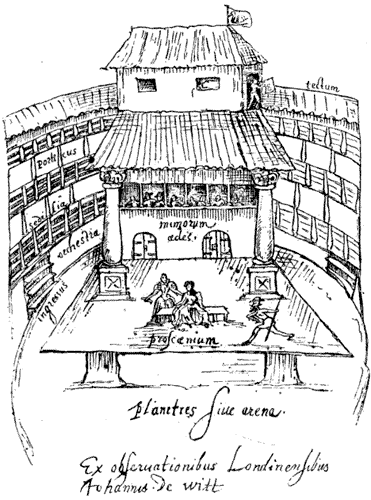
Often playhouses were built by rich businessmen who where willing to invest money into these buildings, as they saw a rising popularity of the touring acting companies. All outdoor playhouses included the following features:

• A central yard that was open to the sky


• A roof over the stage, which was called ‘the heavens’, although the first Rose theatre (1587-92) may not have had one


• A tiring house behind the stage with a backstage area, where actors dressed and waited to come on. Above this were lords’ rooms, rooms for storage, and a room level with ‘the heavens’ to work the special effects from

• Galleried seating all around the yard, on several levels, which was roofed.

• A raised stage sticking out into the yard

Shows where normally put on in the afternoon to make use of the natural day light, the was very much relied on. Plays were performed in repertory, so the same play was never performed two days in a row. This also meant that actors would often be performing and playing many different characters in multiple shows all at one time, with very few rehearsals.

The Red Lion was built in 1567 by John Brayneand was the first playhouse to be built. This was originally an Inn, located in Stepney, outside the city walls. Although there is very little evidence as to weather this establishment was successful, what is clear it must have brought in some interest. As between the 1570's and the 1620's there where many more playhouses built all around the country.


Although there was a lot of attention around Playhouses and they drew in big audiences, not all of this attention was positive. The officials who ran the City of London thought that playhouses were disruptive, and where enticing for unwanted criminal behaviour. So people decided to build playhouses outside the city walls, where there wasn't the control of city officials.


QUESTION: Who were the actors of Shakespeare’s plays and how did the experience of being an actor differ from the experience today?


In Shakespeare’s time acting was an occupation only to be practised by boys and men, and although women were acting other places in Europe at the time, it wasn't until 1660 that women where allowed to perform in public theatres in England.So because of this, boys would play the female parts and occasionally men would play the older female characters.

It was common for actors to began their careers at a young age. They could take up apprenticeships at companies and be taught by the senior actors. It was expected for them to acquire skills in a verity of subjects, such as sword fight, singing, dance, as well as having a good memory for learning lines.


Wednesday, 20 April 2016

Character Research


For our production of Loves Labours Lost I have been cast in the role of Dumaine, a lord at the King of Navarre's court.  Alongside Longaville and Berowne (the two other lords), I have sworn an oath of scholarship to the King.With this attempting to withhold from the company women, in a three year bid to study and fast. However the presence of the Princess of France and her lady's, has lead them astray, as they begin to question there loyalty's.


Our adaptation of this play is to be based in a 40's all men's private members club, similar to that of an American fraternity house or Oxford University's Bullingdon Club. 
An establishment that is not welcoming of women and is strictly for male members only. 

Being the youngest of the four, Dumaines age clearly shows. Although handsome and kind natured, he is not the brightest of the bunch, often displaying his immaturity. He is a terribly poor poet, constantly attempting to be romantic, in hope of wooing his love Katharine. Also when given the opportunity, he enjoys having the chance to mock and laugh at the extent of the Nine Worthies and his fellow lord Berowne.


Copyright © 2016 by PlayShakespeare.com.Visit http://www.playshakespeare.com/license for details.


Saturday, 9 April 2016

Shakespeare's London and Elizabethan Audiences (WEEK3)

Theatre had a lot of controversy surrounding it during the Elizabethan era, with many believing it to be indecent and subversiveAt this time in history, theatre was something only to be attend by the wealthiest and high class figures of society.

London was home to the first permanent playhouse in the country, as previously to that plays were performed in the courtyards of inns. London was also home to royalty and much of the nobility. Many rich noblemen became great supporters and beneficial figures in providing financial and legal support to theatre companies. Royalty also supported the theatre. Between 1603 and 1613 producing work by Shakespeare’s company at the court of King James around 15 times per year. By 1600, London’s theatre-goers numbered 20,000 per week. 

Shakespeare was a playwright for the Globe Theatre during Elizabeth's reign, living and working in London from about 1590 to about 1613. While in London he lived in numerous locations, including St Helens, Silver Street and Paris Gardens in south london.


Tuesday, 22 March 2016

Life of Shakespeare (WEEK2)

It seems that through out history, the man we know as William Shakespeare today has been a very allusive character, with very little hard factual evidence behind his name. In fact some even argue the truth of his existence, with there being very little idea of what he even looked like or the date of his birth. However there are a couple things we do know about this man...


Born in 1564, Shakespeare was the third child in a family of 10, consisting of his mother Mary, the daughter of a local farmer. His farther, John, a glove maker and wool trader and his seven other siblings. He was raised by a very prosperous and successful family, living in large house located in the farming area of Stratford upon-Avon.

At 7 years old, just like many boys of his age, Shakespeare would have attended one of the local grammar school. Here he would have learned to read, speak and write in Latin, along with having to memorise and perform numerous stories from through out history. All useful skills that would benefit him in the future.

In late 1582, Shakespeare married Anne Hathaway –a local farmer’s daughter. William was only 18 years old when he married, which at the time would have been seen as quite young, with most men getting married in there mid to late twenties. But the reasoning behind this became apparent, when within in six months of his marriage the couples first child Susanna was baptised. Later to be followed by two more children, Hamnet and Judith, twins, born in 1585.

Although present in the life of his family, due to his work. The majority of his time was spent 1000 miles away in london,where he mainly resided in from 1590 to 1613. In the capital Shakespeare was a well-known actor and playwright, with his play, Henry VI, performed at the Rose theatre in 1592. He went on to write to write about 40 plays in his life time, along with some 154 sonnets.
       
William Shakespeare past away on 23rd April 1616 and was buried in Holy Trinity church in Stratford-upon-Avon as one of the greatest writers of all time.


Monday, 21 March 2016

Elizabethan England (WEEK1)

The reign of Queen Elizabeth, daughter of Henry VIII lasted from 1558 to 1603, a total of 45 years. It was a very fascinating time in history, marked by a rising middle class, the age of Explorers and Shakespearean theatre.

The countries population boomed during Elizabeths reign, growing from around three million to four. However a third of the population was under 15 and half under 25.

With Elizabeth in power, a once Catholic nation ruled by her sister Mary had been returned to The Church of England. An establishment founded and run by her father Henry VIII. However religion was highly looked upon by people at the time and it was something people felt very strongly about, so many people continued to practice their faith in secret.

Before Elizabeth's reign, reading was a very uncommon subject in society and was mainly put into practice for Bible study. Elizabethan times saw the rise of a strong merchant class, led by weavers and cloth makers. With this, merchants could expect to accumulate wealth and the have the ability to purchase property. Also with literacy becoming far more common under Elizabeth's reign,it enabled apprentices, husbandmen and tradesmen to better ply their crafts. 

Theatre had a lot of controversy surrounding it at this time and was only attended by people of high class and women who could disguise themselves with masks. Shakespeare was a playwright for the Globe Theatre during Elizabeth's reign, but it was located across the Thames River from London, outside the city, where at the time theatre was banned.